

Every year during Christmas time I consider myself very lucky because being German-Polish I am able to combine the traditions of both countries. Growing up in Germany – the country of Christmas markets, Glühwein (German mulled wine) and gingerbread but spending a Polish Christmas in a traditional christian atmosphere. For me it is the perfect mixture to experience both of the greatest Christmas times in the world. Obviously every country has its own traditions but I’ve lived in different countries and I never found the pre-Christmas atmosphere as festive as in Germany.
Whenever I’m living abroad I’m always trying to spend December in Germany. This is the time of Advent (Adventszeit), highly celebrated in my country.
The streets are nicely decorated, you exchange your local bar for the Christmas markets when meeting up with friends and you organize backing sessions with your girlfriends where you exchange ideas for presents (especially for the men because it is always so difficult to buy them something…;)). Companies invite you to corporate Christmas dinners and you invite your friends for a Secret Santa evening. Every day of the December month you open one window of the Adventskalender (advent calendar) to find a little chocolate (or even a little present if the calendar is self-made and offered to you by a friend or family member). Every Sunday you lighten up one of the four candles on the Adventskranz (advent wreath) which decorates our tables during this month. A very enjoyable time!
But…the actual Christmas days are reserved for my family.
Polish people spend this special time in a spirit of tradition and religion. The Christmas time is for us time of reflection, inner peace and quality family time. I wouldn’t exchange those magical moments for any other way of spending Christmas.
Wigilia– the day of the 24.12 is of high importance to us, especially the evening. We are all joined at the table to enjoy a special supper (Wieczerza) – all prepared from the recipes of our mothers and grandmothers (every member of the family is welcome to help in the kitchen). The Wigilia ends traditionally with the Pasterka – a midnight Mass.
The supper consists of 12 dishes (to honor the 12 apostles) and is dominated by fish. Ideally there is no meat at all on this day. We try to eat as light as possible during the day, we dress up around 17:00, put on our polish versions of Christmas Carols (not the ones we hear in American movies but the ones we sing in the church) and switch off our mobile phones. When the first star appears on the sky (this symbolises ‘the moment Jesus was born’) we gather around the table. The ‘head of the family’ – alias my dad – gives each of us a piece of opłatek (very thin piece of unleavened bread which represents the corpus Christi), which is usually sent by family members with their Christmas cards and which we then share between us, giving us blessings.
This is a very mystical moment and I remember when I was a child my grandmother always lost one or two tears at this occasion. Now that she isn’t between us anymore it is usually my turn to sit down to the dinner table with red eyes.
The music in the background is kind of sad but in a nice way and it is usually the moment to remember all our lost friends and family members. I for example have my very own tradition and at this occasion I always wear the earrings my granny offered me before she died. In my mental picture of her she is always wearing them and somehow when I wear them it gives me the feeling she is still here with us.
Another tradition is that we always place one extra plate at the table.
We prepare one additional set for the ‘lost wanderer who is far away from home’ – this being a symbol of Maria and Joseph’s wanderings and asking for a place to stay for the night when Jesus was meant to be born. Some of the families, especially in villages, also tend to place a tiny piece of hay under the table-cloth to symbolize the barn where Jesus was born. The additional place to welcome a hungry guest is a beautiful idea but since in modern times no one ever shows up looking for a shelter, I find it kind of sad that there is an empty seat…
This year Christmas was special to me because for the first time both my brother and I had someone to bring home at the same time. Before either one of us was single or the respective partner (usually mine) was living in a different country and spending Christmas there. Also this year was international since my other half is from ‚a land far, far away’…From the other hemisphere, where families barbecue for Christmas dressed in shorts and a T-shirt.
He was laughing that we have 100 different types of fish but no meat at the table but actually I have to admit a family secret – my mum is cheating and filling the traditional uszka not only with mushrooms but with a very delicious mixture of mushroom-onion-meat-spice filling. Yummy!
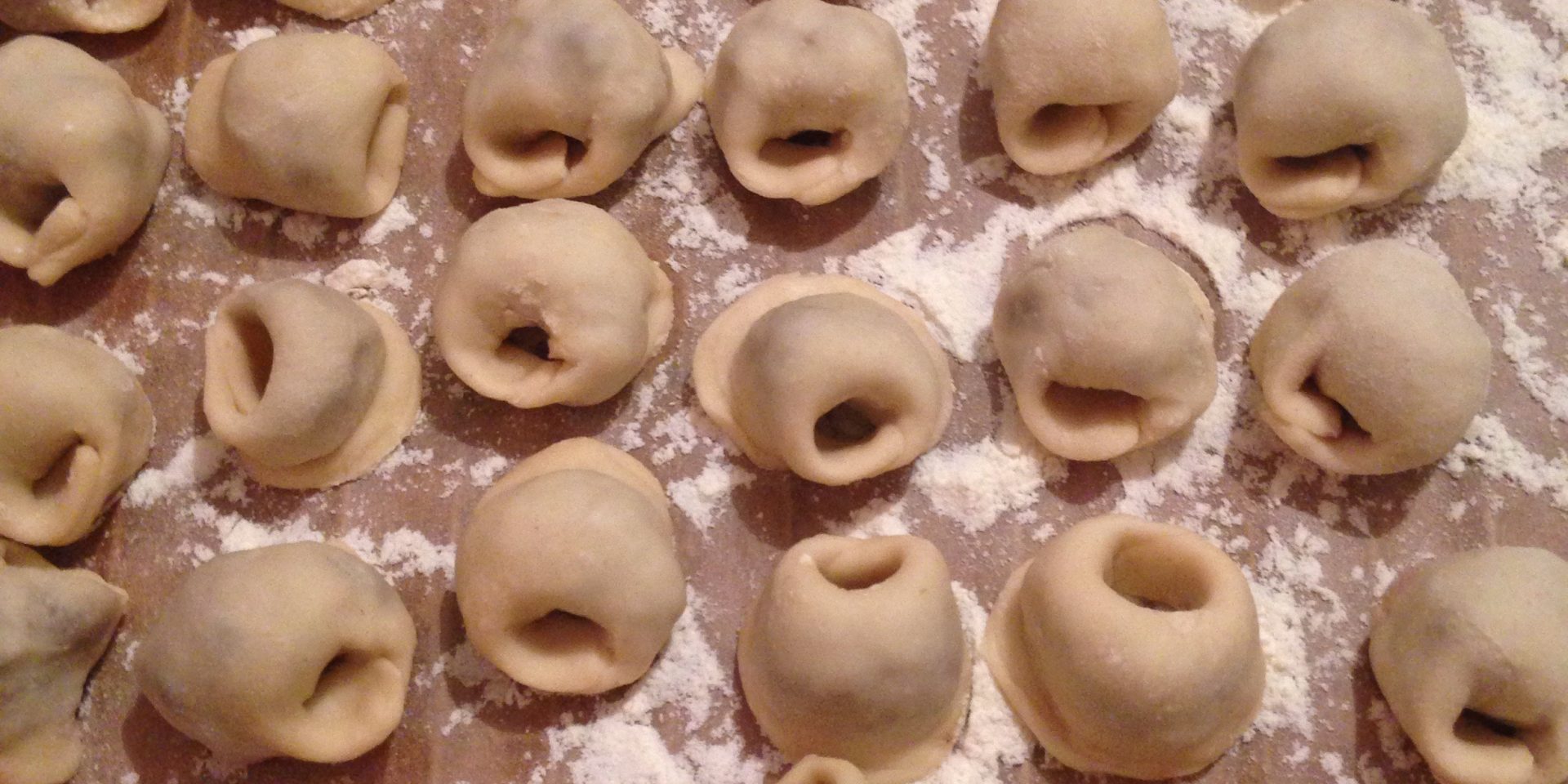
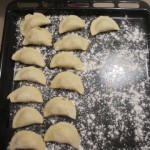
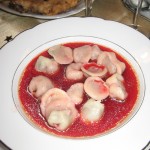
The ‘uszka’ or rather ‘barszcz z uszkami’ is the highlight of the Christmas dinner. Barszcz is a red beet soup and uszka are the polish equivalent to dumplings (or ravioli) but specifically made only for Christmas (with the filling as described above or traditionally as a mushroom-onion only version). They look like little ears – hence the name: uszka means little ears in Polish). You eat them in the soup. A great treat!
Also famous are the pierogi – polish dumplings filled with cabbage and mushrooms.
Let’s not forget the queen among fish – the carp! An absolute must on a polish Christmas table.
On our table we also have potatoes with mushroom sauce, mushroom soup and fish in a variety of sauces, shapes, colors and flavors.
For dessert we usually have ‘makiełki’ or makówki (depending of the region) – a pastry with poppy seeds and ‘kompot z suszonych owoców’ – a punch made of dry fruits. Both deserts are eaten only on Christmas Eve.
There are not only many traditions but also some superstitions around the Christmas time. One of them is that we are not supposed to leave the dinner table before everyone has finished. If someone leaves it means that next year he will ‘not be among us anymore’. I don’t believe in superstitions but somehow I always make sure to go to the toilet just before dinner.
Another one is that you should keep one of the scales of the carp and place it into your purse – it brings you money, they say.
After the dinner it’s time for presents. Polish children don’t have to wait until the morning of the 25th as in many other countries. When my brother and I were children we usually went for a digestive family walk after dinner. Back then global warming was a distant, foreign phrase and we enjoyed slides in the snow! I loved that moment of anticipation mixed with fear of Santa Claus who was about to come round the corner any minute..
Strangely my dad always had to return home for a moment because ‘he forgot something and would catch up with us shortly’. Between me and my brother there is a five-year age difference and I remember the feeling of pretending when I was already a ‘big girl’ and had stopped believing in Santa. I was so proud of keeping the secret with the grown ups that my dad ran back home to prepare the presents and leave the window open – later to tell us stories about how we just missed Santa.
This year we had a child in our family for Christmas. This fact gave the whole evening a new sense and it gave me the feeling of getting my own childhood back. There was again the post-dinner walk to ‘look for Santa’ who in the meantime left the presents under the tree. There was so much enthusiasm back home to see through the child’s eye all those colorful, shiny packets lying under the tree.
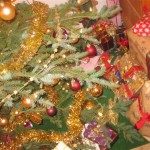
As in regards to the tree – the decoration of it has been my ‘duty’ for years. I love this moment. Glühwein, a rom-com in X-Mas style in the background and me and the tree.
This year I had a little help from the elf called Maria – the new six-year-old member of our family. Lovely.
This Christmas was dominated by children. We spent the following days with my cousins and their kids in different parts of Germany and Poland. Back to Spain we watched the Spanish kids being super excited at the Cabalgata de los Reyes Magos – the parade of the three Kings which takes place on the 5th of January – a colorful procession moving through the streets of Valencia and throwing sweets at the little public. I imagine that on that night the children are not able to fall asleep – full with sweets and excitement, wondering if they will get their presents the following morning. That is to say, in Spain it is not Santa Claus but The Three Magi who bring the presents, on the 6th of January, the Día de Reyes (literally King’s Day).
While children play with their presents, the adults cut the roscón (or ‚pastel de tres reyes’ – a Spanish king’s cake pastry (traditionally eaten to celebrate Epiphany) and share it with family and friends. In one of the pieces there is a little hidden figure (representing the baby Jesus but replaced in modern times by a little toy). Somewhere else in the cake there is also a hidden fava bean. Whoever finds the figure is the ‚king’ of the celebration and can wear the crown for the whole day. Whoever gets the bean has to buy the roscón the following year. This is a Spanish and Latin American tradition. I also experienced it during the time I spent in France. In some parts of France there is a similar cake called ‚galette du roi’ which I shared with friends during my internship in Nantes. I am wondering if I can introduce it to my Polish-German family ?!


1 Comment